
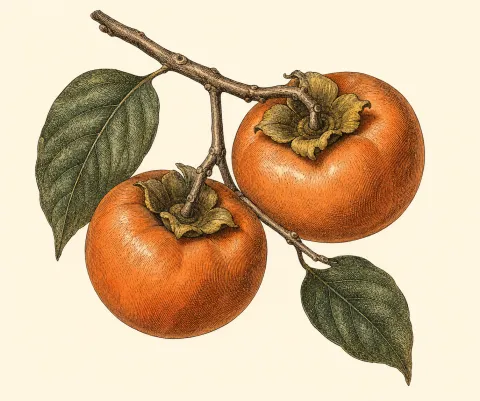
How to Grow Persimmon Trees
Fruit Tree
Persimmons are handsome, low-maintenance fruit trees prized for glossy foliage, brilliant fall color, and sweet orange fruit that ripens after most other crops are done. Home growers plant two main kinds: the American persimmon (Diospyros virginiana), native across much of the eastern and central US, and the larger-fruited Asian or Japanese persimmon (Diospyros kaki). Both reward patient gardeners with heavy crops and very few pest problems compared with many other tree fruits.
Planting
Plant during the dormant season, in late winter or early spring, once the soil can be worked and hard freezes have passed. Choose a full-sun site with deep, well-drained soil; persimmons tolerate a range of soils but dislike soggy ground, and they resent having their long taproot disturbed, so handle the roots gently. Buy grafted trees of a named variety rather than seedlings for predictable fruit, and set bare-root trees at the same depth they grew in the nursery, spreading potted trees' roots as you backfill. Space standard trees about 15 to 20 feet apart, and water them in well after planting.
Pollination
Many Asian varieties, including popular ones like Fuyu and Hachiya, are self-fruitful and will set fruit on a single tree, often producing seedless fruit without any pollinizer. American persimmons usually have separate male and female trees, so a nearby male is generally needed for good fruit set, though some female selections will set fruit on their own. If you have room, planting a second compatible variety often improves fruit size and yield.
Care & pruning
Water young trees regularly through their first two or three seasons to establish deep roots, and give established trees a good soaking during dry spells, especially while fruit is sizing up. Spread a few inches of organic mulch out to the drip line to conserve moisture and suppress weeds, keeping it pulled back from the trunk. Feed lightly in early spring if growth is weak, since too much feeding pushes soft growth and can cause fruit to drop. Prune while dormant to build a strong open framework of well-spaced branches, then thin lightly each year to remove crossing, dead, or crowded wood and to keep the canopy open to light.
Years to bear
Grafted Asian persimmons usually begin bearing about 3 to 5 years after planting. American persimmons and seedling trees often take a few years longer, sometimes 5 to 7 years or more.
Harvest
Harvest in fall, generally from September through November depending on variety and region, cutting or clipping the fruit with a short piece of stem attached rather than pulling it off. Astringent types such as Hachiya must be allowed to ripen until very soft and jelly-like before eating, while non-astringent types like Fuyu can be eaten while still firm and crisp. Firm fruit keeps for a few weeks in the refrigerator, and soft-ripe or pureed persimmon freezes well for later use in baking.
Common problems
Persimmons are among the most trouble-free fruit trees, but they can face occasional issues such as leaf spot, scale insects, and fruit-feeding by birds, deer, and other wildlife. Good air circulation from proper pruning, prompt cleanup of fallen leaves and fruit, and netting or fencing where wildlife pressure is high go a long way toward prevention. For a diagnosis of any specific pest or disease and locally appropriate management, contact your county Cooperative Extension office.
Popular Persimmon varieties to grow
Choose either Asian persimmons for large fruit in milder climates or American persimmons for greater cold hardiness. Many named American selections need a pollinizer for reliable crops, while common Asian cultivars such as Fuyu and Hachiya are generally self-fruitful.
| Variety | Type | Season | Notes | Best for |
|---|---|---|---|---|
| Fuyu | Asian, non-astringent, self-fruitful | late fall | A flat, tomato-shaped persimmon that can be eaten while firm and crisp. Its sweet, mild flavor and non-astringent flesh make it one of the easiest types for beginners. | fresh eating, mild climates |
| Hachiya | Asian, astringent, self-fruitful | late fall | A large, acorn-shaped persimmon with rich orange flesh. It must become fully soft before eating, when it is excellent for baking and puddings. | baking, drying |
| Saijo | Asian, astringent, self-fruitful | mid to late fall | An elongated, very sweet Asian persimmon with soft, jelly-like ripe flesh. It is prized for dessert quality once fully ripe. | fresh eating, drying |
| Ichi-Ki-Kei-Jiro | Asian, non-astringent, self-fruitful | mid to late fall | A compact-growing non-astringent cultivar that produces sweet, firm fruit. It is often recommended for smaller gardens in suitable mild-winter areas. | small gardens, fresh eating |
| Prok | American, cold-hardy, needs pollinizer | mid-fall | A well-known American persimmon with large fruit for the species and rich, sweet flavor when soft. It is suitable for colder regions than most Asian persimmons. | cold climates, fresh eating |
| Yates | American, cold-hardy, needs pollinizer | mid to late fall | An American persimmon cultivar valued for sweet, flavorful fruit and good cold tolerance. The ripe fruit is soft and best eaten fresh or used in desserts. | cold climates, baking |
Variety notes are general guidance for US home gardens; chill hours, hardiness, and pollination needs vary, so confirm suitability for your zone and check with a local nursery. Availability differs by supplier.
Storing Persimmon
Refrigerate harvested persimmons at 32 to 36 F and 90 to 95 percent relative humidity. Firm non-astringent types may keep 1 to 2 months refrigerated, while fully soft astringent fruit is best used within several days to 1 week. Astringent persimmons can ripen off the tree and should become fully soft before eating, whereas non-astringent types can be eaten while firm when fully colored. Freeze whole ripe fruit or pulp for later use, and follow tested USDA or NCHFP recipes for preserves or canning.
Using Persimmon
Ripe persimmons are honey-sweet, silky, and jammy, while some types remain pleasantly crisp when ripe. Eat non-astringent types fresh, or use very soft fruit in puddings, breads, jams, and drying. Astringent persimmons must be fully ripe and soft before eating, because unripe fruit is intensely mouth-puckering and unpleasant.
General guidance for US home growers. Variety and pollination needs vary by region; confirm with your local Cooperative Extension office. Page updated Sep 18, 2026.