
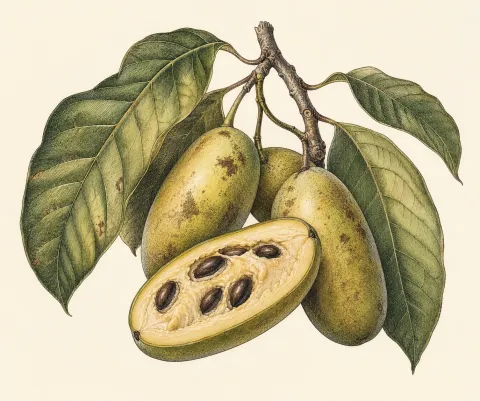
How to Grow Pawpaw Trees
Fruit Tree
The pawpaw (Asimina triloba) is a small deciduous tree native to the eastern United States and bears the largest edible fruit native to North America. Its soft, custard-like flesh has a tropical flavor often compared to banana and mango, which is a big part of why home growers plant it since the ripe fruit is too delicate to ship and is rarely found in stores. As a native species, it also fits well into backyard and edible landscape plantings.
Planting
Plant in early spring after the danger of hard frost has passed, since pawpaws establish best when set out as the growing season begins. Because they have a fragile, brittle taproot and transplant poorly bare-root, it is best to buy container-grown grafted trees from a nursery and disturb the roots as little as possible. Choose a site with deep, rich, moist but well-drained slightly acidic soil, and space trees about 8 to 15 feet apart. Young trees do best with light shade for the first year or two, then need full sun once established to set a good crop.
Pollination
Pawpaws are generally self-incompatible, so you need at least two different varieties planted near each other for cross-pollination and reliable fruit set. The flowers are pollinated by flies and beetles rather than bees, so fruit set can be low, and some growers hand-pollinate with a small brush to improve yields. Planting more than one genetically distinct tree is the single most important step for getting fruit.
Care & pruning
Keep the soil consistently moist, especially during the first few years and in dry spells, because pawpaws do not tolerate drought well. Spread a layer of organic mulch such as wood chips or shredded leaves around the base to hold moisture and moderate soil temperature, keeping it a few inches back from the trunk. Feed with compost or a balanced approach based on a soil test, and water in any feeding well. Prune while dormant in late winter to remove dead or crossing wood and to develop a strong central leader, but keep pruning light since the trees have a naturally pyramidal shape.
Years to bear
Grafted pawpaw trees typically begin bearing fruit about 3 to 5 years after planting. Seedling trees take longer, often 5 to 8 years, and their fruit quality is less predictable.
Harvest
Fruit ripens from late summer into early fall, usually August through October depending on your region. A ripe pawpaw softens slightly like a ripe peach and often drops or detaches easily from the tree, and the flesh should give when gently pressed. Ripe fruit keeps only a few days at room temperature, so refrigerate it to extend storage to about a week, or scoop out and freeze the pulp for longer keeping.
Common problems
Pawpaws have relatively few serious pest and disease problems, though you may see leaf spots, occasional fruit blemishes, and feeding from the zebra swallowtail caterpillar, which uses pawpaw as its only host plant and rarely causes real harm. Good air circulation from proper spacing and light pruning, along with raking up fallen leaves and fruit, helps limit most issues. For an accurate diagnosis and management guidance suited to your area, contact your local Cooperative Extension office.
Popular Pawpaw varieties to grow
Choose at least two genetically different pawpaw cultivars for dependable cross-pollination. Pawpaws are hardy in much of the eastern and central US, and cultivar choice mainly affects fruit size, flavor, seediness, and ripening from late summer into fall.
| Variety | Type | Season | Notes | Best for |
|---|---|---|---|---|
| Shenandoah | large-fruited, needs pollinizer | early fall | A Peterson Pawpaw selection with large, creamy fruit, relatively few seeds, and a mild, sweet flavor. It is widely planted for dessert-quality fruit. | fresh eating |
| Susquehanna | large-fruited, needs pollinizer | early to mid-fall | Produces very large, rich-tasting fruit with firm yellow flesh and relatively few seeds. The fruit is valued for its dense texture and strong flavor. | fresh eating |
| Overleese | productive, needs pollinizer | early fall | An older, reliable cultivar known for large fruit and good production. The flesh is sweet and custardy. | fresh eating |
| Pennsylvania Golden | early-ripening, needs pollinizer | late summer to early fall | A productive selection with sweet yellow flesh and good flavor. It is useful where an earlier pawpaw harvest is welcome. | fresh eating |
| Mango | vigorous, needs pollinizer | early fall | A well-known cultivar with large fruit and a sweet, tropical-style flavor. Despite its name, it is a pawpaw cultivar rather than a mango. | fresh eating |
| KSU-Atwood | named selection, needs pollinizer | early fall | A Kentucky State University release selected for good fruit quality and comparatively low seed content. It has smooth, custardy flesh and is popular with home growers. | fresh eating |
Variety notes are general guidance for US home gardens; chill hours, hardiness, and pollination needs vary, so confirm suitability for your zone and check with a local nursery. Availability differs by supplier.
Storing Pawpaw
Refrigerate ripe pawpaws promptly at 32 to 36 F and high humidity, ideally in a loosely covered container or perforated bag. Fully ripe fruit usually keeps about 3 to 7 days in the refrigerator, while firm fruit may keep up to about 2 weeks. Pawpaws will soften and ripen after picking if harvested mature, so finish ripening them at room temperature and refrigerate once fragrant and yielding. For longer storage, scoop out the pulp, freeze it in airtight containers, or preserve it using a tested USDA or NCHFP recipe.
Using Pawpaw
Ripe pawpaw tastes tropical and custardy, often compared with banana, mango, and melon. Eat the soft flesh fresh with a spoon, or use it in smoothies, ice cream, quick breads, and custards. Do not eat the large dark seeds or the skin, and discard bruised or fermented-tasting fruit.
General guidance for US home growers. Variety and pollination needs vary by region; confirm with your local Cooperative Extension office. Page updated Sep 19, 2026.