
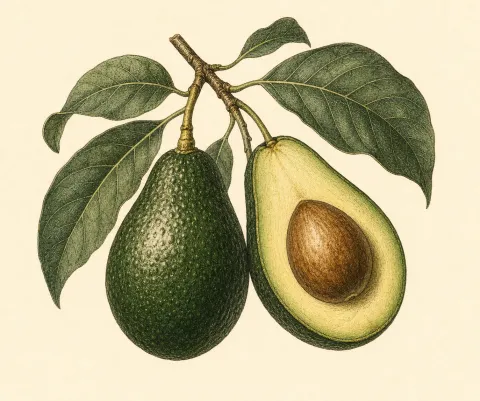
How to Grow Avocado Trees
Fruit Tree
The avocado (Persea americana) is a broadleaf evergreen tree that produces rich, buttery fruit prized for fresh eating. US home growers plant it in mild-winter regions for a steady home supply and for its handsome, glossy foliage and light shade. In the right climate a grafted tree can be productive and long-lived in a backyard.
Planting
Because avocados are evergreen and frost-tender, plant in spring once the danger of frost has passed and the soil has warmed, rather than in winter. Choose a spot with full sun, shelter from wind and cold, and fast-draining soil, since standing water and heavy clay quickly lead to root problems. Set trees roughly 15 to 25 feet apart to allow for their spreading canopy. Buy grafted, named varieties in containers rather than seedlings, disturb the root ball as little as possible, and plant slightly high so the crown does not sit in wet soil.
Pollination
Avocado flowers open in two overlapping stages, and varieties are grouped as type A or type B based on their timing. A single tree is partly self-fertile and will set some fruit on its own, but planting an A-type and a B-type together greatly improves pollination and overall yield. Bees and other insects do the pollinating, so protect them during bloom.
Care & pruning
Water young trees often enough to keep the root zone moist but never soggy, then water established trees deeply and less frequently, letting the surface dry between soakings. Feed lightly and repeatedly through the warm growing season rather than all at once, since the tree takes up nutrients gradually. Spread a coarse organic mulch under the canopy to hold moisture and protect the shallow feeder roots, keeping it a few inches back from the trunk. Prune only to shape the tree, control its height, and remove dead or crossing limbs, ideally after the main frost risk has passed.
Years to bear
Grafted trees usually begin bearing fruit about 3 to 4 years after planting. Trees grown from seed take much longer, often 5 to 13 years, and rarely come true to the parent variety.
Harvest
Avocados mature on the tree but do not soften until after they are picked, so the fruit can hang and hold for weeks or months as a kind of natural storage. Test ripeness by picking one mature fruit and letting it sit at room temperature for a few days; if it softens evenly without shriveling, the rest are ready to pick as needed. Ripen harvested fruit at room temperature and move it to the refrigerator once soft to slow it down.
Common problems
The most serious avocado problem is root rot caused by a soilborne fungus in wet ground, best prevented by planting in well-drained soil and avoiding overwatering. Mites, thrips, scale, caterpillars, and, in parts of the Southeast, laurel wilt can also affect trees, so keep plants healthy, clear fallen debris, and inspect regularly. For local pest identification and current guidance, contact your county Cooperative Extension office.
Popular Avocado varieties to grow
Match avocado variety to climate and cold tolerance, since most need frost-free or well-protected sites. Type A and Type B cultivars can improve fruit set when their flowering overlaps, although a single tree may still bear fruit.
| Variety | Type | Season | Notes | Best for |
|---|---|---|---|---|
| Hass | Type A, dark-skinned | spring through summer | The most familiar US avocado, with pebbly skin that darkens as it ripens and rich, nutty flesh. It is productive in mild climates but has limited frost tolerance. | fresh eating and guacamole |
| Fuerte | Type B, green-skinned | winter to spring | A classic pear-shaped avocado with smooth green skin and creamy, mild flesh. It is somewhat more cold-tolerant than many Mexican-Guatemalan types. | home gardens and pollinating Type A trees |
| Bacon | Type B, cold-tolerant | late fall to spring | A green-skinned cultivar with a lighter, mild flavor and useful cold tolerance for an avocado. It can be a good companion pollinizer for Type A varieties. | cooler avocado areas and pollination |
| Reed | Type A, large fruit | summer | Produces unusually large, round, green-skinned fruit with creamy flesh and a small seed. The fruit can hang well on the tree, extending the home harvest. | fresh eating and extended harvest |
| Mexicola Grande | Type A, cold-tolerant | fall | A Mexican-race avocado with thin, edible dark skin and aromatic flesh. It is among the better choices for marginal, cooler avocado climates, though still needs frost protection in severe cold. | cooler avocado areas and fresh eating |
Variety notes are general guidance for US home gardens; chill hours, hardiness, and pollination needs vary, so confirm suitability for your zone and check with a local nursery. Availability differs by supplier.
Storing Avocado
Store mature, unripe avocados at 60 to 70°F until they yield gently to pressure, then refrigerate them at 36 to 40°F. A ripe avocado generally keeps 2 to 3 days in the refrigerator, while unripe fruit usually needs 3 to 7 days at room temperature. Avocados ripen after harvest, but fruit picked before physiological maturity may soften without developing good flavor. Freeze mashed avocado with lemon or lime juice for best quality, but do not home-can avocado because its low acidity makes it unsuitable for ordinary boiling-water canning.
Using Avocado
A ripe avocado has rich, creamy, buttery flesh with a mild, nutty flavor. It is best sliced fresh, mashed into guacamole, blended into sauces or smoothies, or added to salads, sandwiches, and toast. Eat the flesh only, and do not eat the large pit, skin, leaves, or bark.
General guidance for US home growers. Variety and pollination needs vary by region; confirm with your local Cooperative Extension office. Page updated Sep 19, 2026.