
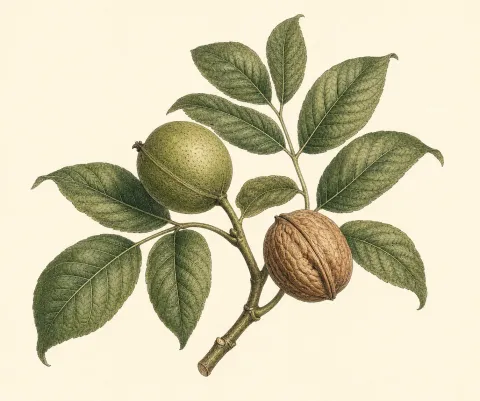
How to Grow Walnut Trees
Nut Tree
Walnuts are large, long-lived deciduous trees grown for their rich, buttery nuts and their generous summer shade. Home growers in the US most often plant English walnut (Juglans regia) for eating-quality nuts and thinner shells, while black walnut (Juglans nigra) is prized for its bold flavor and valuable timber. A single mature tree can supply a family with nuts for decades and doubles as a striking landscape shade tree.
Planting
Plant walnuts during the dormant season, from late fall to early spring, choosing a spot with full sun and deep, well-drained, fertile soil. Because these trees grow very large, give each one 40 to 60 feet of open space away from buildings, septic lines, and power lines. Keep walnuts away from vegetable gardens and sensitive ornamentals, since their roots and leaves release a natural compound called juglone that can stunt or kill nearby plants such as tomatoes and many shrubs. Buy grafted named varieties as bare-root trees while dormant or as potted stock in the growing season, and set the graft union a few inches above the soil line.
Pollination
Walnuts are wind-pollinated and carry separate male and female flowers on the same tree, so they can set some nuts on their own. However, the male and female flowers often mature at different times on a given variety, which limits self-pollination and reduces the crop. Planting a second, compatible variety nearby greatly improves pollination and gives you fuller, more reliable nut set.
Care & pruning
Water young trees deeply and regularly for the first few years, and give established trees a good soaking during extended summer dry spells to keep nuts filling well. Feed lightly in early spring if growth is weak or leaves look pale, and rely on a healthy, well-drained soil rather than heavy feeding. Spread an organic mulch such as wood chips out over the root zone to hold moisture and suppress weeds, keeping it pulled back a few inches from the trunk. Prune young trees in mid-summer to early fall to train a single central leader and well-spaced scaffold branches, avoiding late-winter cuts because walnuts bleed sap heavily then.
Years to bear
Grafted walnut trees typically begin bearing a light crop within about 4 to 8 years after planting, with full production coming later. Seedling and black walnut trees are slower and may take 8 to 15 years to reach meaningful yields.
Harvest
Walnuts ripen in fall, usually from September into October, when the green outer hulls begin to split and the nuts start dropping to the ground. Gather the nuts promptly, remove and discard the hulls right away, then wash off any clinging debris and let the nuts cure in a single layer in a dry, well-ventilated spot for a couple of weeks. Once fully dry, store the in-shell nuts in a cool, dry place, or shell and refrigerate or freeze the kernels for longer keeping.
Common problems
Common walnut troubles include husk fly, codling moth, and aphids among insects, plus fungal and bacterial issues such as walnut blight and anthracnose that show up as spots on leaves, hulls, and nuts. Good sanitation is the best non-chemical defense: rake up and remove fallen nuts, hulls, and leaves each season, prune for open airflow, and avoid crowding trees so foliage dries quickly. For accurate identification and locally tested management options, contact your state Cooperative Extension office or a nearby land-grant university.
Popular Walnut varieties to grow
Walnuts are large, long-lived trees, so match the cultivar to local winter chill, spring-frost risk, and available space. Plant compatible pollinizers when recommended, especially for a dependable nut set.
| Variety | Type | Season | Notes | Best for |
|---|---|---|---|---|
| Chandler | late-leafing, needs pollinizer | late September to October | A leading California walnut with light-colored kernels, good yields, and lateral bearing. Its relatively late leaf-out can help reduce spring-frost exposure. | home orchards, kernel quality |
| Hartley | English walnut, needs pollinizer | late September to October | An established California cultivar with large, attractive light kernels and a classic walnut flavor. It is a terminal-bearing tree and needs room to grow. | traditional home orchards |
| Franquette | late-leafing, needs pollinizer | October | A French-type English walnut valued for very late bud break and good frost avoidance. Nuts are flavorful but generally smaller than Chandler. | areas with late spring frosts |
| Howard | lateral-bearing, needs pollinizer | late September to October | A productive California cultivar with light kernels and a more manageable tree habit than some older walnuts. It is commonly paired with another compatible pollinizer. | home orchards, fresh cracking |
| Tulare | lateral-bearing, needs pollinizer | late September to October | Produces large, well-sealed nuts with light kernels and good yield potential. It leafs out earlier than Chandler, so site it away from frost pockets. | mild-winter orchard sites |
| Serr | large nut, needs pollinizer | late September | Known for very large, attractive nuts and early harvest. It is better adapted to warmer walnut regions than frost-prone locations. | large nuts, warm climates |
Variety notes are general guidance for US home gardens; chill hours, hardiness, and pollination needs vary, so confirm suitability for your zone and check with a local nursery. Availability differs by supplier.
Storing Walnut
Store thoroughly dried walnuts in airtight containers at 32 to 40 F, away from heat, light, and excess humidity. Shelled walnuts generally keep about 6 months refrigerated, while in-shell walnuts can often keep about 1 year. Walnuts do not ripen after harvest, so hull, wash if needed, and dry the nuts completely before storage. Freeze shelled walnuts in moisture-proof packaging for about 1 year or longer, and use tested USDA or NCHFP recipes for any home canning or preserving.
Using Walnut
Walnuts are earthy, rich, slightly bitter, and crisp, with a tender, oily texture. Use them in baking, pesto, salads, granola, walnut butter, and savory dishes, or eat them as a snack. People with tree-nut allergies should not eat walnuts, and walnuts that smell paint-like or taste rancid should be discarded.
General guidance for US home growers. Variety and pollination needs vary by region; confirm with your local Cooperative Extension office. Page updated Sep 19, 2026.