
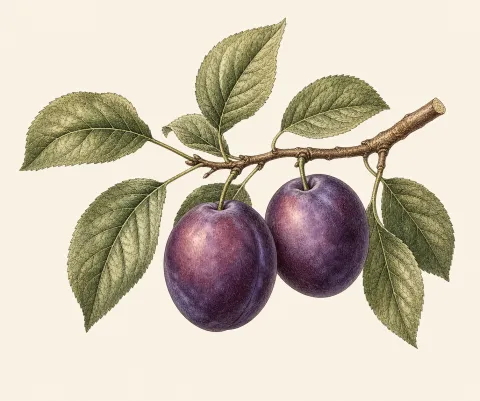
How to Grow Plum Trees
Fruit Tree
Plums are among the easiest stone fruits for home orchards, producing sweet, juicy fruit on a compact, manageable tree. US home growers plant them because they take up little space, begin bearing relatively young, and offer many types, from firm, honey-sweet European plums good for drying to large, juicy Japanese plums for fresh eating. A single healthy tree can supply a family with more fruit than it can eat fresh.
Planting
Plant plums during the dormant season, in late winter or early spring once the ground can be worked, or in fall in mild-winter regions. Choose a site with full sun, at least six to eight hours daily, and well-drained soil, avoiding low spots where cold air and water settle. Space standard trees about 15 to 20 feet apart and semi-dwarf trees roughly 10 to 15 feet apart. Bare-root grafted trees planted while dormant establish very well, though potted trees can go in during the growing season if kept watered.
Pollination
Most European plums are self-fertile and can set a good crop on their own, making them a good choice where space is limited. Japanese plums usually need a second, compatible variety nearby for cross-pollination and a full crop. Even self-fertile types often bear more heavily when another plum blooms at the same time, so planting two compatible varieties is a safe approach.
Care & pruning
Water young trees deeply and regularly during their first couple of seasons, then provide deep soakings during dry spells and while fruit is sizing up. Feed lightly in early spring based on a soil test and the tree's yearly growth, and keep a ring of mulch a few inches deep around the base while holding it back from the trunk to conserve moisture and suppress weeds. Prune while the tree is dormant in late winter, training European types to a central leader and Japanese types to an open-center, vase shape. Thin heavy fruit clusters so the plums stand a few inches apart to improve size and prevent limbs from breaking.
Years to bear
Plum trees usually begin bearing fruit about three to five years after planting. Grafted semi-dwarf trees often reach their first meaningful crop a little sooner than standard-size trees.
Harvest
Plums ripen from midsummer into early fall depending on the variety and your climate. Pick them when they are fully colored, give slightly to gentle pressure, and separate easily from the branch, since plums do not sweeten much once removed from the tree. Eat fresh plums within a week or so, storing them in the refrigerator to extend their life, and use European types for drying or canning if you have a large crop.
Common problems
Common problems include brown rot, which softens and molds ripening fruit, black knot, which forms swollen dark growths on branches, and pests such as plum curculio, aphids, and borers. Prevent trouble by keeping the tree open and airy through pruning, cleaning up fallen and mummified fruit, and cutting out black knot growths well below the swelling during the dormant season. For local pest identification and current, region-specific management advice, contact your county Cooperative Extension office.
Popular Plum varieties to grow
Plums vary widely in hardiness, flavor, and pollination needs, so select cultivars that bloom together and suit your climate. Japanese plums generally ripen earlier and need compatible pollinizers, while European plums often mature later and some are self-fertile.
| Variety | Type | Season | Notes | Best for |
|---|---|---|---|---|
| Santa Rosa | Japanese plum, partly self-fertile | midseason, midsummer | A classic Japanese plum with red-purple skin, amber to reddish flesh, and a sweet-tart flavor. A compatible pollinizer usually improves yields. | fresh eating, jams |
| Methley | Japanese plum, self-fertile | early summer | An early-ripening plum with reddish-purple skin and sweet red flesh. It is productive and can also help pollinate some other Japanese plums. | fresh eating, small gardens |
| Shiro | Japanese plum, needs pollinizer | early to midsummer | A productive yellow plum with translucent yellow flesh and mild sweetness. Its bright fruit is useful for fresh eating and preserves. | fresh eating, jams |
| Satsuma | Japanese plum, needs pollinizer | mid to late summer | A dark red Japanese plum with striking red flesh and a rich sweet-tart flavor. It is especially attractive for jam and fresh use. | jams, fresh eating |
| Stanley | European prune plum, self-fertile | late summer to early fall | A dependable blue-purple prune plum with firm yellow-green flesh. It is a standard cultivar for drying, baking, and canning. | drying, baking, canning |
| Green Gage | European plum, needs pollinizer | late summer | A historic greenish-yellow dessert plum known for exceptionally sweet, richly flavored flesh. It is best grown where a compatible European plum pollinizer is available. | fresh eating, preserves |
Variety notes are general guidance for US home gardens; chill hours, hardiness, and pollination needs vary, so confirm suitability for your zone and check with a local nursery. Availability differs by supplier.
Storing Plum
Store ripe plums at 31 to 32 F with 90 to 95 percent relative humidity. Ripe plums usually keep 3 to 7 days in a home refrigerator, though firm, mature plums may last up to 2 weeks. Plums continue to soften and develop some flavor after picking, so ripen firm fruit at room temperature before chilling it. Freeze halved or sliced plums, or use tested USDA or NCHFP recipes for jams, sauces, or canning.
Using Plum
Ripe plums are juicy, sweet-tart, and tender, with a smooth skin and sometimes firmer flesh near the stone. They are good fresh, baked in cakes and tarts, simmered into jam, dried into prunes, or made into sauces. Do not eat or crush the pit, and remove pits before serving cooked plum dishes.
General guidance for US home growers. Variety and pollination needs vary by region; confirm with your local Cooperative Extension office. Page updated Sep 19, 2026.