
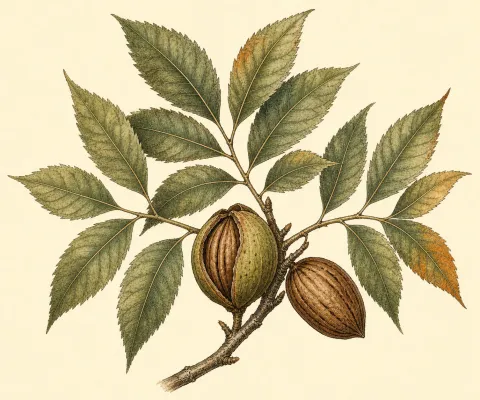
How to Grow Pecan Trees
Nut Tree
The pecan is a large, long-lived hickory native to the southern and central United States, prized for its rich, buttery nuts. Home growers plant it for shade, for a homegrown nut crop, and for a tree that can produce for generations. Be aware that pecans grow very large and take patience, so they suit big yards more than small city lots.
Planting
Plant bare-root, grafted trees during the dormant season, from late fall to early spring while the ground is workable. Choose a grafted named variety rather than a seedling, since grafted trees produce reliable nuts and come true to type. Pick a site in full sun with deep, well-drained soil and space trees widely, at least 40 to 60 feet apart, because a mature pecan can spread very large. Set the tree at the same depth it grew in the nursery, keep the long taproot straight in a deep hole, and water it in well.
Pollination
Pecans are wind-pollinated and, while technically self-fertile, they set far better nut crops when two or more varieties are planted together. Varieties are grouped by when they shed pollen versus when their flowers are receptive, so pairing an early-shedding type with a late-shedding type gives the best overlap. For a dependable harvest, plant at least two compatible varieties within a few hundred feet of each other.
Care & pruning
Water young trees deeply and regularly, especially through the first few summers and during dry spells, since pecans are thirsty and drought stress hurts nut fill. Keep a wide ring of mulch, such as wood chips, around the base to hold moisture and suppress weeds, but pull it back a few inches from the trunk. Feed established trees in early spring based on a soil test and, in many regions, supplement zinc, which pecans commonly need for healthy new growth. Prune in the dormant season to build one strong central leader with well-spaced scaffold branches, and remove any dead, crossing, or low limbs.
Years to bear
A grafted pecan usually begins bearing a light crop in about 4 to 7 years, with fuller production coming around 8 to 12 years. Seedling trees can take much longer, often a decade or more.
Harvest
Pecans ripen in the fall, roughly October into December depending on variety and region, when the green outer husks split open and the nuts begin to drop. Gather nuts from the ground promptly, or shake the limbs to bring down mature ones, and pick them up quickly so they do not mold or get taken by wildlife. Let the nuts dry, or cure, for a couple of weeks in a well-ventilated spot, then store them in a cool, dry place, or freeze in-shell or shelled nuts for long-term keeping.
Common problems
Common pecan troubles include pecan scab, a fungal disease that spots leaves and husks in humid areas, along with aphids, pecan weevil, and nut-feeding casebearers, plus squirrels and crows after the crop. Choosing scab-resistant varieties, spacing trees for good air flow, and raking up and destroying fallen husks and leaves to break disease and pest cycles all help prevent problems. Because pests and diseases vary widely by region, contact your local Cooperative Extension office for guidance tailored to your area.
Popular Pecan varieties to grow
Pecans need a long warm growing season and at least two compatible cultivars for pollination, ideally one Type I and one Type II. Choose cultivars adapted to your region and plan for a fall harvest after the husks split.
| Variety | Type | Season | Notes | Best for |
|---|---|---|---|---|
| Pawnee | Type I pollinator, early harvest | early fall | A widely planted cultivar with large, high-quality nuts and an early harvest. Its early maturity makes it useful in areas with a shorter pecan season. | home orchards, earlier harvest |
| Kanza | Type II pollinator, scab-resistant | mid to late fall | Known for good nut quality, strong kernel percentage, and useful resistance to pecan scab. It pairs well with Type I cultivars such as Pawnee. | humid regions, home orchards |
| Lakota | Type II pollinator, scab-resistant | midseason, fall | A University of Missouri release with high-quality nuts and good resistance to pecan scab. It is valued for dependable production in many eastern growing areas. | humid regions, home orchards |
| Desirable | Type I pollinator, large nut | mid to late fall | A long-established southern cultivar that bears large, attractive pecans with good kernel quality. Disease management may be needed where pecan scab is common. | warm climates, fresh nuts |
| Elliott | Type II pollinator, scab-resistant | late fall | Produces smaller nuts with excellent flavor and a high kernel percentage. It is especially valued in humid southeastern climates for strong scab resistance. | humid regions, baking |
| Stuart | Type II pollinator, traditional cultivar | late fall | A classic, vigorous pecan cultivar with medium to large nuts. It remains common in older southern plantings and can serve as a pollinizer for Type I trees. | warm climates, home orchards |
Variety notes are general guidance for US home gardens; chill hours, hardiness, and pollination needs vary, so confirm suitability for your zone and check with a local nursery. Availability differs by supplier.
Storing Pecan
Store clean, fully dried pecans in airtight containers at 32 to 40 F, with low to moderate humidity to prevent mold and rancidity. Shelled pecans commonly keep 6 to 9 months in the refrigerator, while in-shell nuts may keep about 1 year under good conditions. Pecans do not ripen after harvest, so let freshly harvested nuts dry and cure before storage. Freeze shelled pecans in moisture-proof packaging for 2 years or more, and use tested USDA or NCHFP recipes for any home canning or preserving.
Using Pecan
Pecans are rich, sweet, buttery, and crisp when fresh, with a softer bite than many nuts. Use them for snacking, pralines, pecan pie, baking, granola, salads, and savory stuffing. People with tree-nut allergies should not eat pecans, and shelled nuts should be discarded if moldy or rancid.
General guidance for US home growers. Variety and pollination needs vary by region; confirm with your local Cooperative Extension office. Page updated Sep 19, 2026.