
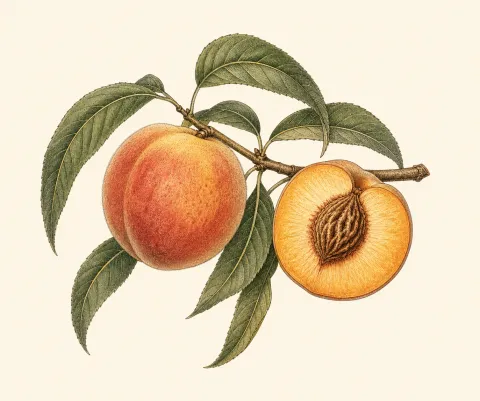
How to Grow Peach Trees
Fruit Tree
Peaches are a favorite backyard fruit tree because a single healthy tree can supply a family with sweet, juicy fruit for weeks in mid to late summer. Home growers plant them for flavor that store-bought peaches rarely match, since tree-ripened fruit can be picked at its peak. Standard, semi-dwarf, and genetic dwarf types make peaches practical for both full-size yards and small spaces or large containers.
Planting
Plant during the dormant season, in late winter or early spring once the soil can be worked, using either a bare-root or a potted grafted tree from a reputable nursery. Pick a spot with full sun, at least six to eight hours a day, and well-drained soil, since peaches quickly decline in soggy ground. Space standard trees about 15 to 20 feet apart and semi-dwarf trees roughly 12 to 15 feet apart, giving each tree room for air and light. Set the tree at the same depth it grew in the nursery, keeping the graft union a couple of inches above the soil line.
Pollination
Most peach varieties are self-fertile, so a single tree will set fruit on its own without a pollinator partner. This makes peaches a good choice for small yards where there is room for only one tree. A few varieties benefit from a second peach nearby, so check the label or ask your nursery when you buy.
Care & pruning
Water deeply and regularly during the first two years while roots establish, and give mature trees a steady supply of moisture as fruit swells, aiming for even soil moisture rather than swings between wet and dry. Spread a few inches of organic mulch out to the drip line to hold moisture and limit weeds, but keep it pulled back from the trunk. Feed lightly in early spring based on a soil test and the tree's growth, since too much encourages soft growth over fruit. Prune every year in late winter to an open-center or vase shape, removing crossing, dead, and inward growth so sunlight and air reach the fruiting wood.
Years to bear
A grafted peach tree usually begins bearing fruit two to four years after planting. It reaches full production around year four or five, once the framework of branches is well developed.
Harvest
Peaches ripen from mid to late summer, depending on the variety and your climate, and are ready when the background color shifts from green to yellow or cream and the fruit gives slightly to gentle pressure. Pick with a light twist and lift so the fruit separates easily from the branch, handling it carefully to avoid bruising. Ripe peaches keep only a few days at room temperature, so refrigerate to hold them a little longer, or freeze, can, or dry the surplus.
Common problems
Common peach problems include peach leaf curl, brown rot, borers, and various fruit-eating insects, along with a leaf-spot disease that shows up in wet seasons. Good prevention starts with choosing disease-resistant varieties, keeping the center of the tree open for air flow, cleaning up fallen fruit and leaves, and thinning young fruit so clusters do not touch. For an accurate diagnosis and a management plan suited to your area, contact your local Cooperative Extension office.
Popular Peach varieties to grow
Match peach cultivars to your winter chill and hardiness zone, since bloom timing and cold tolerance strongly affect crops. Most peaches are self-fertile, so one tree can bear fruit, but choosing early, midseason, and late cultivars can extend the harvest.
| Variety | Type | Season | Notes | Best for |
|---|---|---|---|---|
| Redhaven | self-fertile, cold-hardy | midseason, midsummer | A classic freestone peach with firm yellow flesh and balanced sweet-tart flavor. It is widely grown because it crops reliably and handles colder peach regions well. | fresh eating, canning |
| Elberta | self-fertile, freestone | late season, late summer | An old standard with large yellow freestone fruit and traditional peach flavor. It is a dependable choice for processing as well as eating fresh. | canning, baking, fresh eating |
| Contender | self-fertile, cold-hardy | mid to late summer | Produces large, flavorful yellow freestone peaches and is noted for good flower-bud hardiness. It is often chosen for areas with colder winters or occasional spring frosts. | cold climates, fresh eating |
| Reliance | self-fertile, very cold-hardy | early to midseason, midsummer | A hardy peach developed for northern growing regions. Its fruit is juicy and best when tree-ripened. | cold climates, canning |
| O'Henry | self-fertile, yellow freestone | late summer | A large, attractive peach with rich flavor, firm flesh, and good eating quality. It is especially common in warmer peach-growing regions. | fresh eating, baking |
| Bonanza | self-fertile, genetic dwarf | midseason, midsummer | A compact genetic dwarf peach that can produce full-size yellow freestone fruit. Its smaller stature makes pruning and picking easier. | containers, small gardens |
Variety notes are general guidance for US home gardens; chill hours, hardiness, and pollination needs vary, so confirm suitability for your zone and check with a local nursery. Availability differs by supplier.
Storing Peach
Store ripe peaches at 32 to 36 F with 90 to 95 percent relative humidity, handling them gently to prevent bruising. Once ripe, they generally keep 3 to 5 days in the refrigerator. Peaches continue to soften off the tree if picked mature, so ripen firm fruit at room temperature, then refrigerate it when it gives slightly to pressure. Freeze peeled sliced peaches with an appropriate anti-browning treatment, or use tested USDA or NCHFP recipes for canning, jams, or other preserves.
Using Peach
A ripe peach is juicy, sweet, floral, and softly tender, with either velvety skin or smooth skin on nectarines. It is excellent fresh, grilled, baked into cobblers and pies, made into jam, or sliced and frozen. Do not eat or crush the pit, and refrigerate cut peaches promptly.
General guidance for US home growers. Variety and pollination needs vary by region; confirm with your local Cooperative Extension office. Page updated Sep 19, 2026.