
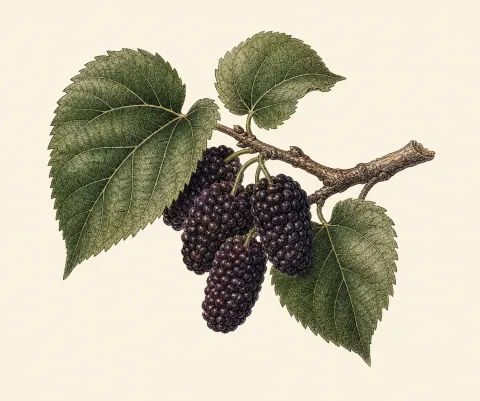
How to Grow Mulberry Trees
Fruit Tree
Mulberries (Morus species) are fast-growing, adaptable deciduous trees prized for their sweet, blackberry-like fruit and generous summer harvests. Home growers plant them because they bear heavily with little fuss, tolerate a wide range of soils and urban conditions, and produce a soft, perishable fruit that is rarely sold in stores. The most common types are the native red mulberry, the widely naturalized white mulberry, and the richly flavored black mulberry.
Planting
Plant during the dormant season, in late winter to early spring, choosing a full-sun site with well-drained soil and plenty of room, since standard trees can grow large and wide. Space full-size trees about 25 to 30 feet apart, or less for dwarf and everbearing types, and keep them away from patios, walkways, and driveways because the ripe fruit drops and stains. Mulberries tolerate a broad pH range and most soil types, but they perform best in deep, fertile, loamy ground. Buy grafted named varieties or potted nursery trees for reliable fruit quality, and set bare-root trees at the same depth they grew in the nursery.
Pollination
Many mulberries are self-fertile and will set fruit as a single tree, so most home growers need only one. Some trees are dioecious, meaning individual plants are male or female, and a few can shift their flowering; choosing a named female or self-fruitful variety avoids ending up with a fruitless tree. Wind carries the pollen, so no insects or hand-pollination are required.
Care & pruning
Water young trees regularly through their first two or three growing seasons to establish deep roots, then water during extended dry spells, since established mulberries are notably drought-tolerant. Mulberries are vigorous and seldom need much feeding; a spring topdressing of compost and a layer of organic mulch kept a few inches from the trunk will conserve moisture and suppress weeds. Prune while the tree is dormant in late winter to remove dead, crossing, or crowded branches and to keep the canopy at a manageable height, but avoid heavy cuts because large wounds bleed sap and heal slowly. Train young trees to a strong central leader or an open framework of well-spaced scaffold limbs.
Years to bear
Grafted and named nursery trees typically begin bearing within about 2 to 3 years, while seedling trees may take 5 or more years to fruit.
Harvest
Mulberries ripen over several weeks from late spring into summer, and the berries are ready when they are fully colored, soft, and detach easily. Because ripe fruit falls readily, the simplest method is to spread a clean sheet or tarp under the tree and gently shake the branches, harvesting every day or two during the season. The fruit is very perishable, so refrigerate it and use it within a few days, or freeze it for longer storage.
Common problems
Mulberries are generally trouble-free, and birds are usually the biggest challenge, so lightweight netting draped over smaller trees is the most effective protection for the crop. Occasional issues include leaf spots, a fungal condition called popcorn disease that swells individual fruits, and scale insects; raking up fallen fruit and leaves and keeping the tree well pruned for good airflow helps prevent most problems. For identification of a specific pest or disease and management options in your area, contact your local Cooperative Extension office.
Popular Mulberry varieties to grow
Choose mulberries for your space, fruit color, and whether you want a low-maintenance tree or a compact selection. Fruit-bearing trees are generally self-fruitful, but ripe fruit can stain paths and attract birds.
| Variety | Type | Season | Notes | Best for |
|---|---|---|---|---|
| Illinois Everbearing | self-fruitful, long-bearing | early summer through summer | Illinois Everbearing produces long black berries with a sweet-tart, blackberry-like flavor over an extended period. It is one of the best-known fruiting mulberries for home gardens. | fresh eating, pies, extended harvest |
| Dwarf Everbearing | self-fruitful, dwarf | summer | A compact mulberry commonly grown in containers or small gardens, with sweet dark fruit. Its manageable size makes pruning and harvest easier than with standard mulberry trees. | containers, small yards, fresh eating |
| Pakistan | self-fruitful, long black fruit | late spring to summer | Pakistan mulberry bears exceptionally long, dark purple-black fruit with a sweet flavor. It is best in warm climates because severe cold can damage the tree. | fresh eating, warm climates |
| White Pakistan | self-fruitful, pale fruit | late spring to summer | White Pakistan bears long pale berries that ripen creamy white to pinkish and are notably sweet. It is suited to warm regions and offers less dark staining than black-fruited types. | fresh eating, warm climates |
| Wellington | self-fruitful, black fruit | early summer | Wellington is an old, well-regarded black mulberry selection with large, flavorful fruit. It is grown chiefly for fresh use and desserts. | fresh eating, baking |
Variety notes are general guidance for US home gardens; chill hours, hardiness, and pollination needs vary, so confirm suitability for your zone and check with a local nursery. Availability differs by supplier.
Storing Mulberry
Store mulberries unwashed at 32 to 34°F and 90 to 95 percent relative humidity in a shallow, loosely covered container. They are very perishable and usually keep just 1 to 3 days in the refrigerator. Mulberries do not ripen after harvest, so harvest them fully colored, soft, and easily released from the stem. Freeze them in a single layer before packing, dry them, or use tested USDA or NCHFP recipes for jams and preserves.
Using Mulberry
Ripe mulberries are soft, juicy, and delicate, with a sweet berry flavor that can be mildly tart. They are best eaten fresh soon after picking, or used in pies, cobblers, jam, syrup, wine, juice, and drying. Eat fully ripe berries and discard unripe, damaged, or moldy fruit.
General guidance for US home growers. Variety and pollination needs vary by region; confirm with your local Cooperative Extension office. Page updated Sep 18, 2026.