
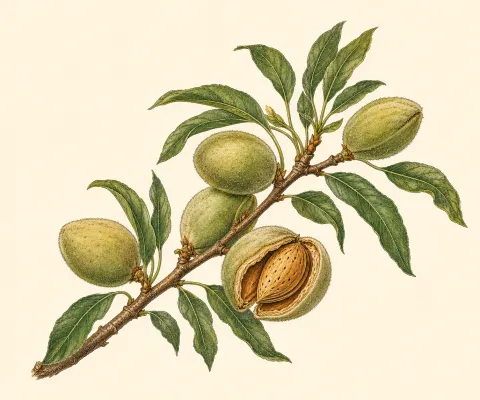
How to Grow Almond Trees
Nut Tree
The almond (Prunus dulcis) is a small to medium deciduous tree closely related to the peach, prized for its sweet, oval kernels and its early clouds of pink-white spring bloom. US home growers plant it for a homegrown nut crop, for the ornamental flowers, and because a mature tree is productive and long-lived in the right climate.
Planting
Plant during the dormant season, from late winter into early spring, once the soil can be worked and hard frost has passed. Choose a full-sun site with deep, well-drained soil, since almonds will not tolerate wet or soggy roots; avoid low frost pockets where cold air settles. Space standard trees about 15 to 20 feet apart and semi-dwarf types a bit closer to allow good air movement and light. Buy a grafted bare-root tree in the dormant season or a healthy potted tree, setting it so the graft union stays a couple of inches above the soil line.
Pollination
Most almond varieties are self-unfruitful and need a second, compatible variety nearby that blooms at the same time to set a crop through cross-pollination. Plan to plant at least two different varieties within about 50 feet of each other, and encourage bee activity since bees do the pollen transfer. A few self-fertile varieties exist and can fruit on their own, which is helpful where space is tight.
Care & pruning
Water young trees deeply and regularly through their first few years to establish roots, then give established trees deep, infrequent soakings during the dry summer while easing off as harvest nears. Feed in early spring with a balanced approach based on a soil test, and spread a few inches of organic mulch out to the drip line while keeping it back from the trunk to hold moisture and limit weeds. Train young trees to an open-center (vase) shape in the first couple of years so light and air reach the interior. Prune lightly each year in the dormant season or after harvest to remove dead, crossing, or crowded wood and to keep the canopy open.
Years to bear
Almond trees usually begin bearing a light crop about 3 to 4 years after planting and reach full production around 5 to 6 years.
Harvest
Almonds are ready in late summer to early fall when the green outer hulls split open and dry, revealing the shell inside. Harvest by shaking the limbs or knocking the nuts down onto a tarp, then remove the hulls promptly and spread the nuts to dry until the kernels are firm and rattle in the shell. Store the cured, in-shell or shelled nuts in a cool, dry place, or refrigerate or freeze them to keep the kernels fresh longer.
Common problems
Common concerns include aphids, mites, and navel orangeworm, along with fungal diseases favored by wet weather such as brown rot and shot hole, plus damage from squirrels and birds. Prevent trouble by keeping the canopy open for airflow, cleaning up fallen nuts, mummies, and leaf litter that harbor pests, and watering at the ground rather than wetting the foliage. For pest identification and locally tested control guidance, contact your county Cooperative Extension office.
Popular Almond varieties to grow
Choose almond varieties for your winter chill, spring frost risk, and pollination plan. Most almonds need a compatible pollinizer, while a few home-garden selections are self-fertile.
| Variety | Type | Season | Notes | Best for |
|---|---|---|---|---|
| Nonpareil | light-colored, needs pollinizer | late summer to early fall | The leading California shelling almond, valued for a soft shell and attractive, high-quality kernel. It needs compatible pollen from another almond cultivar. | fresh nuts and home orchards with pollinizers |
| All-In-One | self-fertile | late summer to early fall | A popular self-fertile almond for home gardens, producing paper-shell nuts with sweet kernels. It is useful where space allows only one tree. | small home orchards |
| Mission | dark-skinned, needs pollinizer | late season | A California cultivar with a harder shell and darker kernel skin than Nonpareil. Its rich flavor is especially appreciated for roasting and baking. | roasting and baking |
| Carmel | soft-shell, needs pollinizer | late season | A productive California cultivar often planted as a pollinizer for Nonpareil. It has a relatively soft shell and plump, light-colored kernels. | pollinizing Nonpareil and fresh nuts |
| Monterey | hard-shell, needs pollinizer | late season | A vigorous, productive cultivar with a well-sealed shell and good-quality kernel. It is commonly paired with compatible California almond varieties. | home orchards with multiple almond trees |
Variety notes are general guidance for US home gardens; chill hours, hardiness, and pollination needs vary, so confirm suitability for your zone and check with a local nursery. Availability differs by supplier.
Storing Almond
Store freshly harvested, hulled almonds in an airtight container at 32 to 45°F with low humidity, ideally below 65 percent relative humidity. Properly dried kernels keep about 6 to 12 months refrigerated and up to 2 years frozen, while warm pantry storage shortens quality. Almonds do not ripen after harvest, so let them dry thoroughly before storage. Freeze kernels in a moisture-proof container for longest keeping, or roast them for shorter-term pantry use.
Using Almond
Ripe almonds are crisp and firm, with a mild, buttery, slightly sweet flavor. They are excellent for snacking, baking, granola, almond butter, praline, or grinding into flour. Eat only sweet almonds sold or grown for eating, because bitter almonds can contain dangerous cyanide-forming compounds and should not be eaten raw.
General guidance for US home growers. Variety and pollination needs vary by region; confirm with your local Cooperative Extension office. Page updated Sep 18, 2026.