
How to Grow Serviceberry (Juneberry)
Bush Berry
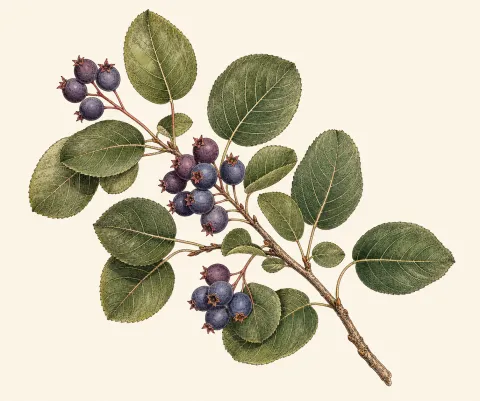
Serviceberry is a multi-stem shrub or small tree that produces sweet purple-blue fruit in late spring to early summer. It also offers white blossoms and strong ornamental value in the landscape. For home gardeners, shrubby forms are often the easiest to manage for fruit production.
Planting
Plant serviceberry in full sun to light shade, with fuller sun giving the best fruit production. Use well-drained soil and provide enough room for the plant's mature height and spread. Spring or fall planting works well in most climates. Water after planting and mulch the root area to help retain moisture and suppress weeds.
Care
Water during establishment and during extended dry periods, especially in hot summers. Prune mainly to remove dead, damaged, or crossing branches and to maintain an open structure. If growing a multi-stem shrub form, thin stems as needed to improve airflow and harvest access. Protect young trunks from mechanical injury and keep turf from crowding the root zone.
Harvest
Fruit ripens quickly once it turns deep blue to purple, and birds often harvest it before gardeners do. Pick as soon as berries are fully colored and sweet. The fruit is delicate, so shallow containers help reduce crushing.
Common problems
Rusts, leaf spots, fire blight, and cedar related diseases can affect serviceberry in some regions. Birds are often the most immediate challenge at harvest. Pruning for airflow, removing diseased twigs, cleaning up fallen debris, and using netting can reduce losses.
Popular Serviceberry (Juneberry) varieties to grow
Serviceberries are very cold-hardy small trees or shrubs, and cultivar choice should match your space, desired fruit size, and ornamental interest. Many set some fruit alone, but planting more than one compatible selection can improve crops; protect ripening berries from birds.
| Variety | Type | Season | Notes | Best for |
|---|---|---|---|---|
| Northline | hardy, suckering | early summer | Northline is a hardy Saskatoon serviceberry with large, flavorful blue-purple fruit and a spreading, suckering habit. It is a reliable choice for northern gardens. | cold climates, preserves |
| Smoky | hardy, productive | early summer | Smoky is a classic Saskatoon cultivar with sweet, dark fruit and heavy yields. Its fruit is popular for pies, muffins, and preserves. | baking, jams |
| Thiessen | large-fruited, hardy | early summer | Thiessen is known for some of the largest fruit among Saskatoon serviceberries. The berries have a sweet, mild flavor and are good eaten fresh. | fresh eating, cold climates |
| Regent | compact, hardy | early summer | Regent is a compact serviceberry suited to smaller landscapes, with white spring flowers and edible dark fruit. Its relatively restrained size makes it easier to fit into a home planting. | small gardens, ornamental edible landscapes |
| Honeywood | hardy, upright | early to mid summer | Honeywood produces sweet, dark berries on an upright, productive shrub. It is a dependable cultivar for colder regions. | fresh eating, freezing |
| Autumn Brilliance | tree form, ornamental | early summer | Autumn Brilliance is a serviceberry hybrid valued for white spring bloom, edible dark fruit, and notably colorful fall foliage. It is commonly grown as a multi-stem specimen or small tree. | edible landscaping, small yards |
Variety notes are general guidance for US home gardens; chill hours, hardiness, and pollination needs vary, so confirm suitability for your zone and check with a local nursery. Availability differs by supplier.
Storing Serviceberry (Juneberry)
Store ripe serviceberries at 32 to 36°F with 90 to 95% relative humidity, and use them within 3 to 5 days. Serviceberries do not ripen well after picking, so harvest fully purple to blue-black, sweet fruit. Freeze dry berries in a single layer before packing for 8 to 12 months of best quality; for pie filling, jam, or other home-canned products, use tested USDA or NCHFP recipes because of food safety.
Using Serviceberry (Juneberry)
Ripe serviceberries are sweet and juicy with a mild blueberry-like flavor, almond-like notes, and soft flesh around small seeds. They are good for fresh eating, pies, muffins, crisps, jam, jelly, syrup, wine, and drying. The small seeds are normally eaten with the fruit. Pick berries only when fully purple to blue-black, because pink or red fruit is not fully ripe and tastes less sweet.
General guidance for US home gardens. Variety and hardiness vary by region; check with your local Cooperative Extension office. Page updated Sep 19, 2026.