
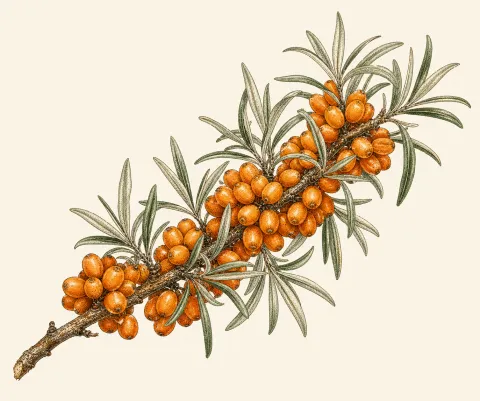
How to Grow Seaberry (Sea Buckthorn)
Bush Berry
Seaberry is a hardy, thorny shrub grown for dense crops of orange berries and strong tolerance of wind and poor soils. It is often used in edible hedges or as a barrier planting. Male and female plants are separate, so a male pollinizer is needed for fruit production.
Planting
Plant seaberry in full sun, where it will receive enough light to flower and fruit well. Use a well-drained site because the plant does not tolerate waterlogged soil. Include at least one male plant near female plants for pollination if fruit is desired. Allow generous spacing because mature shrubs can spread and may produce suckers.
Care
Water during establishment, but avoid overwatering once plants are rooted. Prune to remove dead wood, control suckers, and maintain access around the thorny branches. Because fruit forms on older wood, avoid excessive annual pruning that removes too much productive growth. Keep weeds and turf from competing with young plants.
Harvest
Berries ripen from late summer into fall, depending on climate and variety. Harvest can be slow because fruit is borne tightly along thorny branches. Some gardeners clip fruiting branchlets selectively, but care is needed to avoid over-pruning next year's crop.
Common problems
Scale insects, leaf spots, and branch cankers may occur, especially on stressed plants. Poor drainage and overcrowding can weaken shrubs and increase disease pressure. Full sun, careful pruning, clean tools, and removal of damaged wood help prevent recurring problems.
Popular Seaberry (Sea Buckthorn) varieties to grow
Seaberry is very hardy and drought tolerant once established, but most fruiting cultivars are female and require a compatible male pollinizer nearby. Choose cultivars for fruit color, ripening window, and manageable thorniness, then allow room for a suckering shrub.
| Variety | Type | Season | Notes | Best for |
|---|---|---|---|---|
| Leikora | female, orange fruit | late summer to early fall | A widely planted German female cultivar with heavy crops of orange berries. It is vigorous and dependable in cold climates. | cold climates, juice, processing |
| Hergo | female, orange fruit | late summer | Hergo is a productive female selection known for relatively large orange fruit. Its upright habit can make harvest somewhat easier than on very sprawling plants. | home orchards, preserves |
| Orange Energy | female, orange fruit | late summer to early fall | A female cultivar grown for abundant, brightly colored fruit on vigorous plants. It is commonly paired with a male cultivar for pollination. | juice, ornamental edible hedges |
| Botanica | female, large-fruited | late summer | Botanica is a female selection prized for comparatively large, orange fruit and good yields. Like other seaberries, it needs a male plant to set fruit. | fresh processing, cold climates |
| Lord | male pollinizer | - | Lord is a male seaberry cultivar grown for pollen rather than fruit. Plant it near female cultivars, with wind carrying pollen through the planting. | pollinating female seaberries |
| Pollmix | male pollinizer | - | Pollmix is a male selection used to pollinate female sea buckthorn cultivars. It produces no harvestable berries itself. | pollinating female seaberries |
Variety notes are general guidance for US home gardens; chill hours, hardiness, and pollination needs vary, so confirm suitability for your zone and check with a local nursery. Availability differs by supplier.
Storing Seaberry (Sea Buckthorn)
Store ripe seaberries at 32 to 36°F with 90 to 95% relative humidity, and use them within about 5 to 7 days. Seaberries do not ripen after harvest, so pick fully colored berries at their intended flavor and acidity. Freeze berries promptly for 8 to 12 months of best quality, which is often easier than holding them fresh; for juices, jams, or other home-canned products, use tested USDA or NCHFP recipes because of food safety.
Using Seaberry (Sea Buckthorn)
Ripe seaberries are juicy but pulpy, intensely tart, and citrus-like, often with a tropical or pineapple-like note and some astringency. They are usually sweetened for juice, syrup, jelly, sauce, sorbet, fruit leather, and preserves rather than eaten by the handful. The fruit and its small seeds are edible. Pick fully colored ripe berries and use fruit only from plants that have not been treated with pesticides not labeled for edible crops.
General guidance for US home gardens. Variety and hardiness vary by region; check with your local Cooperative Extension office. Page updated Sep 19, 2026.