
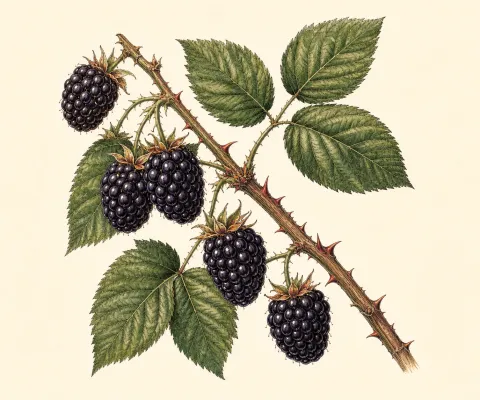
How to Grow Marionberry
Bramble
Marionberry is a trailing blackberry type prized for high-quality dark fruit and vigorous growth. It is widely grown in the Pacific Northwest and performs best where summers are moderate and cane diseases are kept in check. Home gardeners should expect to train and prune it much like other trailing blackberries.
Planting
Plant marionberry in full sun in well-drained soil and provide a trellis before canes begin to sprawl. Choose a site with good air movement and enough room for annual cane training. Space plants so new and old canes can be managed separately. Water deeply after planting and mulch to limit weeds and conserve soil moisture.
Care
Provide consistent moisture during active growth and fruiting, but avoid prolonged soggy soil. After harvest, cut out fruited canes and train new primocanes onto the support for the next season. Thin weak or excess canes to improve airflow and make harvest easier. Keep the planting clean of weeds and remove pruned material from the area.
Harvest
Harvest when berries are fully black, glossy, and detach easily. Fruit quality is best with frequent picking because ripe berries soften quickly. Refrigerate soon after harvest for best keeping quality.
Common problems
Cane and leaf diseases, fruit rots, and spotted wing drosophila pressure can reduce harvest quality in some regions. Dense growth and overripe fruit increase trouble. Timely harvest, sanitation, pruning for airflow, and exclusion netting where practical help reduce losses.
Popular Marionberry varieties to grow
Marionberry is itself the cultivar Marion, a thorny trailing blackberry developed in Oregon, and true marionberry choices are consequently limited. Give plants a trellis, mild-to-moderate winter conditions, and space for floricanes that bear in summer.
| Variety | Type | Season | Notes | Best for |
|---|---|---|---|---|
| Marion | thorny, trailing blackberry | mid summer | The classic marionberry has intensely flavored black fruit with a balance of sweetness and tartness. It is a leading choice for frozen fruit, pies, jam, and other processing. | baking, jam, freezing |
| Willamette Thornless Marion | thornless Marion mutation | mid summer | A thornless mutation of Marion selected for fruit with the familiar Marion flavor profile. It offers a more comfortable picking experience while retaining trailing growth. | home gardens, preserves |
Variety notes are general guidance for US home gardens; chill hours, hardiness, and pollination needs vary, so confirm suitability for your zone and check with a local nursery. Availability differs by supplier.
Storing Marionberry
Store ripe marionberries at 32 to 36°F with 90 to 95% relative humidity, and use them within 2 to 3 days. Marionberries do not ripen after picking, so harvest fully black, glossy berries and cool them promptly. Freeze dry berries on a tray before packing for 8 to 12 months of best quality; for jam, jelly, or any home-canned product, use tested USDA or NCHFP recipes because of food safety.
Using Marionberry
Ripe marionberries are juicy and tender, with a rich, deep blackberry flavor that is sweet, tart, and slightly earthy. They are excellent fresh and especially prized in pies, cobblers, jam, preserves, sauces, smoothies, and freezing. The seeds are edible, though they add noticeable crunch. Harvest berries only when fully black, plump, and easily detached, then discard berries with mold or spoilage.
General guidance for US home gardens. Variety and hardiness vary by region; check with your local Cooperative Extension office. Page updated Sep 18, 2026.